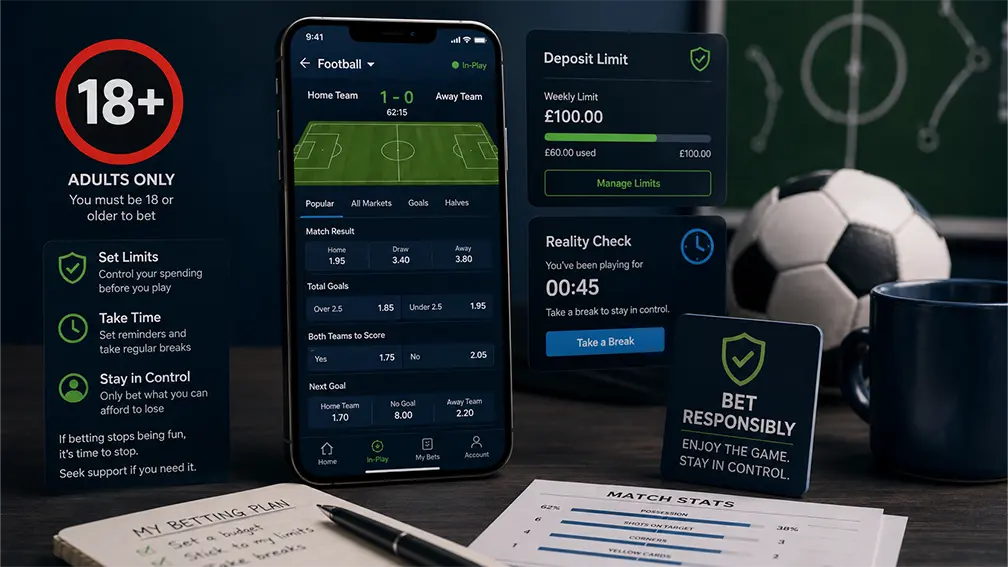
This page gives UK players a calm way to manage gambling before pressure grows. Safer play means setting limits, spotting warning signs, using help early, and protecting money, time, relationships, plus wellbeing. You will find practical account controls, recognised UK services, and behaviour checks linked to football, racing, accumulators, in-play markets, and betting routines.
What responsible gambling means for UK sports betting users
For UK sports betting users, responsible betting means placing wagers with clear limits, leisure money only, and a plan before prices move. It includes taking breaks, refusing to chase losses, and asking for help before pressure becomes harder to manage. Football, racing, tennis, and darts feel familiar, which lowers caution. Live odds, accumulators, bet builders, and packed fixture lists add speed, choice, plus emotion. A small stake across several markets still creates risk when repeated often. Safer play starts with rules for spend, time, mood, and stop points, not with the result of one slip.
How responsible gambling protects your money, time, and betting decisions
Better decisions start before selection, price, or market type. Use disposable income only, then decide what stake size fits the event. A football weekend with ten fixtures, a full racing card, or fast in-play market gives more chances to act on mood. Written rules reduce bill risk, stake jumps after losses, and bets placed during stress. These responsible betting tips keep each slip inside planned limits.
- Budget: set one affordable amount from leisure money, then stop once used.
- Stake: choose a fixed unit, avoid raising it after a losing bet.
- Event count: cap fixtures or races before opening the app.
- Time limit: decide session length before kick-off, first race, or live play.
- Stop point: leave after a set loss, win, or emotional trigger.
When normal betting habits start to become gambling harm
Early action works best before debt, secrecy, or stress grows severe. These problem gambling signs are signals to slow down, use account controls, or speak with trained help. They do not diagnose anyone. They show patterns worth taking seriously.
- Chasing losses: pause when the next bet aims to recover money quickly.
- Hidden activity: review behaviour when slips, deposits, or account use become secret.
- Borrowing: stop staking where loans, credit, or favours fund gambling.
- Missed bills: treat rent, utilities, food, and travel as non-negotiable costs.
- Longer sessions: use a timeout when betting runs past planned limits.
- Extra accounts: avoid using another profile to bypass controls.
- Anxiety without betting: seek support when missed matches create tension or panic.
Why licensed UK betting sites must provide safer gambling support
Players using licensed UK bookmakers should expect visible account controls, age checks, safer gambling pages, and routes to help. This protects users before problems grow. Account menus should include limits, timeout options, self-exclusion routes, activity records, marketing controls, and access to support contacts. Footer links and help areas should make these features easy to find before deposits, live betting, withdrawals, or bonus use. Stronger visibility gives players practical control, especially during busy sport schedules.
Responsible gambling tools that can help you stay in control
Practical controls work best before pressure builds. Responsible online gambling includes account limits, bank controls, blocking software, support routes, and stronger exclusion options. Set them before Premier League weekends, Cheltenham, Grand Slam tennis, darts events, payday, or tournament finals. Short-term tools slow spending and play. Stronger blocks remove access for longer periods when stopping matters more than adjusting limits.
| Tool type | Typical purpose | Best time to use it | Key limitation |
|---|---|---|---|
| Deposit cap | Restricts account funding | Before payday or major fixtures | Does not control existing balance |
| Loss cap | Limits betting losses | Before live markets open | Availability varies by operator |
| Reality reminder | Shows session time | During long sports schedules | Requires you to act |
| Timeout | Stops short access | After stress or losses | Usually temporary |
| Bank block | Stops card deposits | When repeated funding starts | Different banks apply different delays |
| Self-exclusion | Blocks gambling access | When stopping becomes necessary | Needs commitment across accounts |
Deposit limits, loss limits, and reality checks before you play
Account controls work in different ways. Deposit limits restrict money entering a betting balance. Loss caps focus on money lost after wagers settle. Stake controls reduce exposure on single slips. Reality checks remind you how long a session has lasted. Use figures as personal examples, not universal targets. A low cap gives stronger protection than a high ceiling built around worst-case behaviour.
| Tool | Example numerical setting | What it controls | Who it suits |
|---|---|---|---|
| Deposit cap | £25 per week | Account funding | Players limiting payday spending |
| Daily loss cap | £10 per day | Settled losses | Users who chase after poor results |
| Single stake control | £2 per bet | Slip size | Football acca or racing users |
| Session reminder | 30 minutes | Time spent logged in | In-play or live score watchers |
| Market pause | 24 hours | Access after pressure | Anyone betting during stress |
Time-out tools and cooling-off breaks during busy sports periods
A short break helps when sport volume turns betting into habit. The time-out feature differs from account closure or long exclusion because access stops for a set cooling-off period, then returns after expiry. Use it before payday, after losses, or when a match, race, or live price starts affecting mood. Responsible betting means stepping away while control still feels possible.
- Football weekend: pause before multiple kick-offs create repeated slip checks.
- Racing festival: take a break when every race starts to feel urgent.
- Tennis major: stop before late matches extend play past planned hours.
- Losing run: lock access when the next stake targets recovery.
- Payday pressure: set a break before new funds reach betting accounts.
Self-exclusion through bookmaker account blocks
Self-exclusion is a stronger control for anyone who needs gambling access stopped for a fixed period. A bookmaker block limits one account, while a wider self-exclusion scheme covers participating operators. Do not bypass exclusion through new profiles, borrowed details, offshore sites, or another person’s account. Account closure suits players who want to end access to one betting profile, but it does not replace a wider block where gambling needs to stop.
Bank gambling blocks, blocking software, and spend tracking tools
Controls outside a bookmaker account add friction when repeated deposits or debt become a pattern. They help show total spend across accounts, reduce impulse funding, and slow access during emotional moments. Responsible gambling advice should include money tools because betting risk often appears first in bank records, card payments, and hidden app activity.
- Bank blocks: switch on gambling merchant restrictions inside your banking app.
- Payment restrictions: remove saved cards and block gambling payments where available.
- Device blocking: install software to limit access on phones, laptops, and tablets.
- Spending alerts: enable notifications for card use, transfers, and low balances.
- Budget apps: review weekly totals across accounts before placing another bet.
Organisations and services that can help with gambling support
Support needs differ by situation. Gambling harm prevention covers first contact help, treatment routes, peer meetings, debt advice, budget planning, and urgent emotional support. A football bettor chasing losses needs a different route from someone facing arrears, panic, or family strain. Use the table to match the issue with a practical next step.
| Organisation | Service type | Access method | Location coverage |
|---|---|---|---|
| National Gambling Helpline | First contact gambling support | 0808 8020 133, live chat, https://www.gamcare.org.uk/get-support/talk-to-us-now/ | Great Britain |
| GamCare | Advice, treatment access, online help | 0808 8020 133, [email protected], https://www.gamcare.org.uk/ | Great Britain |
| GambleAware | Information and support signposting | Support finder, online routes, https://www.gambleaware.org/ | Great Britain |
| National Gambling Support Network | Local and online treatment routes | Support finder through https://www.gambleaware.org/ | Great Britain |
| NHS gambling clinics | Specialist clinical treatment | Clinic referral, [email protected], https://www.nhs.uk/live-well/addiction-support/gambling-addiction/ | England, by clinic area |
| Gamblers Anonymous | Peer group meetings | 0330 094 0322, [email protected], https://gamblersanonymous.org.uk/ | England, Wales, Ulster |
| StepChange Debt Charity | Debt advice | 0800 138 1111, online form, https://www.stepchange.org/ | UK |
| MoneyHelper | Budgeting and money guidance | 0800 011 3797, online form, https://www.moneyhelper.org.uk/en | UK |
| Samaritans | Emotional listening support | 116 123, [email protected], https://www.samaritans.org/ | UK and Ireland |
| GAMSTOP | Online self-exclusion | 0800 138 6518, [email protected], https://www.gamstop.co.uk/ | Great Britain licensed operators |
National Gambling Helpline for free 24 hour help
The National Gambling Helpline is a first contact point when betting feels hard to control. Use it for repeated deposits, loss chasing, debt worries, secrecy, or concern about someone close. Advisers provide confidential information, advice, and routes into further help. This responsible gambling route suits urgent conversations before account tools, bills, or relationships reach breaking point.
| Phone | 0808 8020 133 |
|---|---|
| Website URL | https://www.gamcare.org.uk/get-support/talk-to-us-now/ |
| Email address | [email protected] |
| Online chat | Available through the website URL |
| Opening hours | 24 hours a day, 7 days a week |
| Best use | First help for betting control, debt pressure, or family concern |
GamCare support for betting behaviour, treatment, and live chat
GamCare support covers gambling behaviour, affected others, and routes into trained help. It fits situations such as chasing football losses, hiding racing bets, making repeated deposits, or worrying about a partner’s account use. Live chat, phone help, email support, forums, and online treatment routes give several entry points. The service works best when early contact happens before debt, secrecy, or stress grows.
| Phone | 0808 8020 133 |
|---|---|
| Website URL | https://www.gamcare.org.uk/ |
| Email address | [email protected] |
| Online chat | Available through https://www.gamcare.org.uk/get-support/talk-to-us-now/ |
| Opening hours | 24 hours a day, 7 days a week |
| Extra routes | Forums, chatrooms, online appointments, treatment referrals |
GambleAware guidance and access to the National Gambling Support Network

GambleAware advice helps users understand gambling risk, warning behaviour, and help options. It works as a signposting route rather than a bookmaker tool. A bettor worried about in-play habits, account deposits, or family pressure gets directed towards free help, local services, and online routes. Use it when you need direction before choosing treatment, debt help, or exclusion.
| Phone | 020 7287 1994 for organisational contact |
|---|---|
| Website URL | https://www.gambleaware.org/ |
| Email address | [email protected] for registered charity contact |
| Support finder | Available through the website URL |
| Online chat | Help routes link to 24 hour adviser chat |
| Best use | Risk information, support direction, and network access |
NHS gambling clinics for specialist treatment and mental health support
NHS gambling clinics suit cases where problem gambling signs connect with severe loss of control, addiction concerns, mental health strain, or major financial harm. Specialist clinical support differs from account limits because it addresses wider wellbeing and behaviour. Availability, eligibility, and referral routes vary by clinic area. Use NHS information, a GP, or local clinic details when basic controls no longer give enough protection.
| Phone | 020 7381 7722 for the National Gambling Clinic |
|---|---|
| Website URL | https://www.cnwl.nhs.uk/services/addictions/national-gambling-clinic |
| Email address | [email protected] |
| General NHS information | https://www.nhs.uk/live-well/addiction-support/gambling-addiction/ |
| Referral route | Clinic self-referral, professional referral, or GP discussion, depending on area |
| Emergency help | Call 999 if there is immediate risk to life or safety |
Gamblers Anonymous meetings for peer support and recovery

Gamblers Anonymous offers peer support through meetings with people who understand gambling harm. This is different from clinical treatment, bookmaker controls, or debt advice. A meeting gives space to speak, listen, and build accountability with others facing similar behaviour. Gambling harm prevention also involves community contact, especially where secrecy has grown. Linked family support routes exist for affected relatives.
| Phone | 0330 094 0322 |
|---|---|
| Website URL | https://gamblersanonymous.org.uk/ |
| Email address | [email protected] |
| Public relations email | [email protected] |
| Online meetings | https://gamblersanonymous.org.uk/meeting/ |
| Best use | Peer meetings for shared experience and ongoing accountability |
StepChange Debt Charity for gambling debt and repayment plans
Debt help becomes relevant when betting affects bills, borrowing, credit cards, overdrafts, or family money. StepChange deals with money pressure, not betting predictions. Use debt advice early, before arrears, fees, or payday loans make the position harder. Responsible betting tips should never replace professional debt support.
Money pressure signals
Use these checks when gambling has moved beyond leisure spending. One sign is enough to pause betting and speak to a debt adviser.
- Missed bills: rent, council tax, energy, or food costs have fallen behind.
- Credit gambling: cards, overdrafts, or loans now fund deposits.
- Payday borrowing: short-term loans cover losses or living costs.
- Family debt: friends or relatives lend money after betting losses.
- Hidden balances: bank statements, bookmaker deposits, or repayments stay secret.
| Phone | 0800 138 1111 |
|---|---|
| Website URL | https://www.stepchange.org/ |
| Email address | Use online form at https://www.stepchange.org/send-us-an-email.aspx |
| Online debt advice | https://www.stepchange.org/start.aspx |
| Opening hours | Monday to Friday 8am to 8pm, Saturday 9am to 2pm |
| Best use | Debt review, repayment options, and creditor pressure |
MoneyHelper for budgeting, bills, and safer money decisions
MoneyHelper supports budgeting, bills, spending records, and general money guidance. It differs from StepChange because the focus sits on planning and everyday money decisions rather than formal debt repayment. Responsible betting starts with separating essential costs from leisure spend. Budget tools help after gambling losses by showing income, bills, credit commitments, and spare money before another deposit reaches a bookmaker account.
| Phone | 0800 011 3797 |
|---|---|
| Website URL | https://www.moneyhelper.org.uk/en |
| Email address | Use online form at https://www.moneyhelper.org.uk/en/contact-us |
| Webchat | Available through https://www.moneyhelper.org.uk/en/contact-us |
| +44 7701 342744 | |
| Best use | Budget planning, bill separation, and monthly spending review |
Samaritans for urgent emotional support when gambling feels overwhelming
Samaritans offers immediate human support when gambling harm brings panic, shame, relationship pressure, or thoughts of self-harm. This is not a betting account tool. It gives space to speak with a listening volunteer at any time. If someone faces immediate danger, emergency services are the right route. Problem gambling signs often include emotional distress, so urgent support matters alongside debt, exclusion, and treatment steps.
| Phone | 116 123 |
|---|---|
| Website URL | https://www.samaritans.org/ |
| Email address | [email protected] |
| Online chat | Pilot service through https://www.samaritans.org/how-we-can-help/contact-samaritan/chat-online/ |
| Opening hours | 24 hours a day, 7 days a week |
| Emergency help | Call 999 where there is immediate risk to life or safety |
Responsible Gambling Advice
Betting is fun, enthralling, a rush, a risk, a gamble, addictive and can be a problem. Most people who gamble on a semi regular basis, do it in their spare time around popular sporting events. The majority being football on a Saturday afternoon, some bet on horse racing and some other events like tennis and cricket. Its mainly televised events that encourage the bulk of wagers, so its perceived to be part of the entertainment value.
We’re not here to preach to you about gambling and how to stop, quit, give up etc. But gambling responsibly and being aware of the risks is important. Here are 7 steps to being a responsible gambler, compiled from the experiences of controlled gambling enthusiasts.
- Step 1: Budget
- Step 2: Deposit Limit
- Step 3: Rules
- Step 4: Research
- Step 5: Don’t Reinvest
- Step 6: Be A Realist
- Step 7: Walk Away
Step 1: Budget
Budgets are key to any environment where spending money is involved. You only have so much coming in, therefore you can’t have more going out. If you have you no consideration for how much is going out, compared to how much is coming in, then you have a problem. You are irresponsibly spending money and that’s an unsustainable approach – that means eventually you’ll go broke.
The best advice I was ever given was to keep a budget and stick to it. As a gambler you’ll know the days when gambling or the temptation is at its peak, Saturday for example is full of horse racing and football. A lot of people go out either shopping or drinking/socialising, so spending is normally a theme for the day. I stick to £25 a Saturday and split that over 3 or 4 select bets. When you stray from that system you’re in problem territory, because a budget is a system of control and focus. It sounds like an overreaction but as soon as you go over your budget or drift away from your system, you’ve lost control.
Step 2: Deposit Limit
If you find you struggle with sticking to a budget, you can put physical measures in place, by way of deposit limits on each betting site. To support responsible gambling, I have a £25 daily deposit limit on my chosen bookies. This isn’t because I’ve had a problem, I put these deposit limits in place from the day I joined each betting site. Your bank can also assist in the matter of responsible spending, you can limit daily cash withdrawals from machines to say £50.
Spending limits are not just for people with money issues, they are well used by responsible people. The worst thing you can do is begrudge a system like this because you think its just for those with problems. Anyone can accidentally over spend one day and without a limit in place, the one day you feel flush, could be that one day when you blow your bank balance because you couldn’t stop.
Affluence is actually a proven trait in the gamblers psyche. what that means is that we can spend money like we’re rich, even if we don’t have it. The feeling of spending large sums of cash, makes us feel wealthy. But we often disregard the consequences under these circumstances, because the rush of spending or being ‘affluent’ delivers falsle positive emotions.
Step 3: Rules
If you ever come across a seasoned responsible gambler, you may notice they have rules. We’ve written some football betting rules ourselves here. Now whilst they’re designed to be a bit of fun, they’re also true. We stick to these rules so we know at the end of the day, we’ve avoided placing rash or reckless bets. Some rules are sentimental, like not betting on your own football team. Whilst others are from experience, like not chasing the big odds on huge accas because you think you can win that big bet. Or chasing a profit so you pick a less likely bet with bigger odds so you can make your money back.
Step 4: Research
Would you buy a car or a house without looking at it first or researching the important information like the energy efficiency, the age etc. Well it baffles me how so many people scroll through betting sites with just a set of odds to inform them of the likelihood of a result. Sports betting is very much circumstantial and with a little research there are circumstances surrounding events that are likely to influence your pick. Manager sackings change the dynamic of a football match, changes in whether can upset the going of a horse race. So when you pick your bets if you haven’t done the slightest bit of research then you shouldn’t be surprised if it loses.
Step 5: Don’t Reinvest
A common mistake that a lot of gamblers make is reinvesting their wins outside of their normal gambling pattern. When you’ve had a big win, there is an immediate temptation to reinvest larger sums of money into a similar bet. We often base these moments of lavish spending on the notion that ‘your lucks in’. The luck that brought you the big win in the first place is unlikely to repeat itself, so hemorrhaging large sums of money from your win pot is a naive mistake to make.
Firstly you’re creating a feeling of comfort towards spending those larger amounts of cash. Where else would you spend such large amounts in one go, with a possibility of losing it all. Secondly you’ve altered your financial thermostat, you’ve increased your base bet and pushed up your minimum spend comfort zone. A prime example is when you bet on horse racing, perhaps you start off with £1 e/w bets and that gets you nervous, you feel the excitement and fun. You have a big win like £20 and on the next few races you start wagering your profits at a rate of £5 e/w.
It’s all good fun and you didn’t start out with that cash anyway, so it’s not a big deal right? WRONG! In a lot of cases, those that have increased their minimum bet limits will stay at the new figure, so in our example £5 has become that punters new minimum. In problem cases, this cycle repeats itself over and over again – until gamblers are wagering hundreds of pounds per play.
Step 6: Be A Realist
Remember, the odds are stacked against you pretty much all the time. Otherwise these betting sites, companies, bookies will all be out of business. So respect the notion that the ball is firmly in their court when it comes to who has the upper hand. The house always wins, means that inevitably the people walking away with the biggest profits are those taking your money. If you’re controlled and honest with yourself, gambling can be exciting and fun. But the bookies are there to make money, so be respectful of yourself, your money and your livelihood. Only ever bet what you can HAPPILY afford to throw away.
Step 7: Walk Away
If you’ve stuck to your budget, stuck to your limit, stuck to your rules and you’ve still lost. The most important, mature and responsible action you can take is accept defeat and walk away. Gambling is a test of ego, we’re backing our knowledge of an event with real money. There has to be a fair amount of ego behind those decisions and with that in mind we sometimes find it hard to admit defeat. That’s often why we backtrack without reasonable judgement, we try and chase a win and get some money back.

James Whitmore is Editor-in-chief at BookiesReviews.co.uk, where he leads bookmaker reviews, betting guides and UK sports betting coverage. James is a football, horse racing and boxing fan, a Burnley supporter, and follows the NFL through the Green Bay Packers.His industry experience includes roles with Betfair, Paddy Power and Oddschecker, giving him practical knowledge of bookmakers, odds comparison and player-focused betting content.