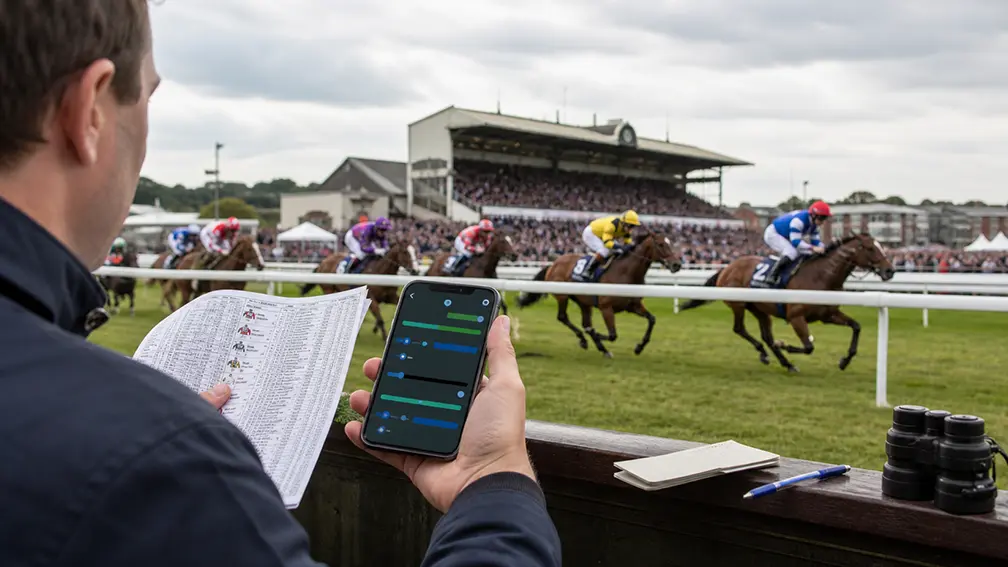
Each way means 2 bets in one: 1 win part and 1 place part. A £10 each way selection costs £20. Final returns depend on odds, stake, place fraction, runner count, race type, and finishing position. No system removes risk, so check terms before every slip.
What each way betting means for horse racing
An each way bet backs 2 outcomes on one horse. The first part needs victory. The second part needs a paid position. This horse racing betting terminology matters in big fields, festivals, handicaps, and races where picking the winner looks less clear. It is not free cover, because both parts carry separate stakes.
| Bet part | What must happen | Odds used | Payout result |
|---|---|---|---|
| Win | Horse wins | Full quoted odds | Win return plus stake |
| Place | Horse lands inside paid places | Fractional place odds | Place return plus stake |
| Win loses | Horse finishes second or lower | No win odds paid | Win stake lost |
| Outside places | Horse misses paid positions | No odds paid | Both stakes lost |
How each way bets split your stake
A £10 each way bet costs £20. One £10 stake goes on the win part. Another £10 stake goes on the place part. The bookmaker bet slip total should show the full charge before you confirm. Confusing the unit stake with the total cost creates early bankroll errors.
| Each way stake | Win part | Place part | Total cost |
|---|---|---|---|
| £2 each way | £2 | £2 | £4 |
| £5 each way | £5 | £5 | £10 |
| £10 each way | £10 | £10 | £20 |
Why the win and place parts matter
The win part uses full quoted odds. The place part settles at reduced terms, known as each way place odds. A horse priced at 10/1 pays the win portion at 10/1, while the placing portion uses the fraction attached to that race. If your pick finishes inside paid places without winning, only the place side returns money.
| Part | Odds basis | Qualifying result | Example outcome |
|---|---|---|---|
| Win part | Full odds | First place only | 10/1 pays as 10/1 |
| Place part | Reduced odds | Advertised paid places | 10/1 at 1/5 pays as 2/1 |
What happens when your horse places
When a runner finishes second, third, fourth, or another paid position, the win part loses and the place part settles at reduced odds. Racecard place terms decide which positions count. For example, a £5 each way selection at 8/1 with 1/5 terms pays only the place side after second place. Outside advertised positions, both parts lose.
| Result | Win part | Place part | Return type |
|---|---|---|---|
| Horse wins | Wins | Wins | Full win return plus place return |
| Horse finishes second | Loses | Wins if second is paid | Place return only |
| Horse finishes fourth | Loses | Wins only where fourth is paid | Conditional place return |
| Horse finishes outside terms | Loses | Loses | No return |
How each way bets work on racecards
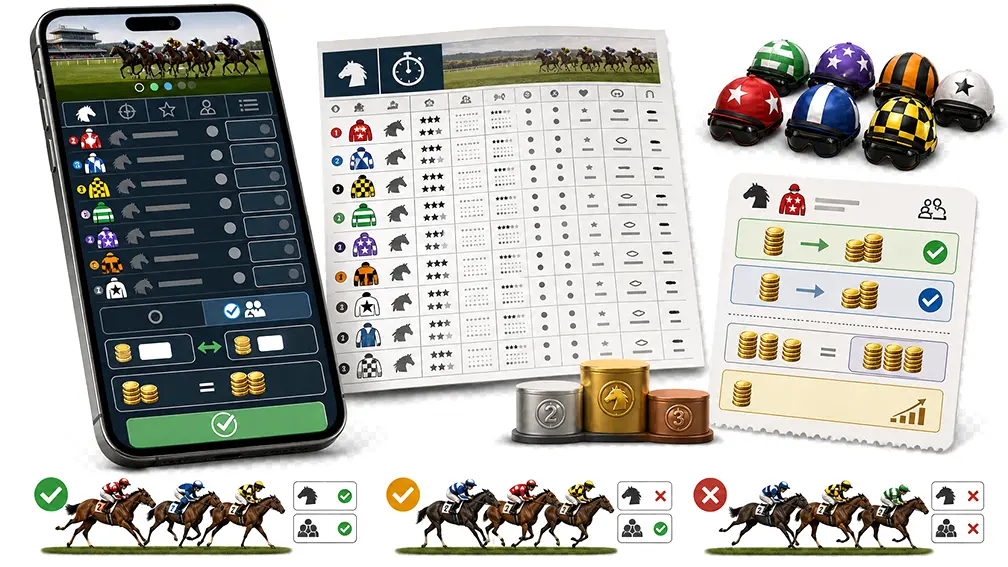
A racecard shows the basic details needed before staking: race time, runner names, odds, class, distance, and declared runners. The bet slip then confirms whether each way selection applies. UK players should read both screens before pressing confirm, because field size, race type, and paid positions change returns. A small interface detail changes the final cost or outcome.
| Item shown | Example detail | Why it matters | Stake mistake to avoid |
|---|---|---|---|
| Race time | 15:30 | Confirms the target race | Backing the wrong event |
| Runner name | Horse A | Matches your selection | Picking a similar name |
| Odds | 8/1 | Sets win return | Ignoring price changes |
| Field size | 12 runners | Affects paid places | Assuming fixed places |
| Each way box | Ticked | Doubles stake cost | Missing the total |
| Paid places | 1, 2, 3 | Controls place return | Counting unpaid fourth |
Where you select each way online
Most online racecards show each way status on the bet slip after you choose a horse. The control often appears as a box, toggle, or label beside the stake field. Some races, specials, or forecast-style markets run win only, so confirm the option appears before entering money. Review the bet slip total, selected runner, quoted price, and paid positions before you place the wager.
Experienced horse racing trader and editor with a demonstrated history of working in the bookmaking industry.
Stephen Harris, Senior Horse-Racing Editor, betting industry and racing trading specialist
How the total bet stake changes
After you select each way, the total stake doubles because the wager splits into 2 equal parts. A £5 displayed stake becomes £10, with £5 for the win and £5 for the place. A £10 displayed stake becomes £20. Use the total, not the unit figure, for any payout calculation.
| Displayed stake | Win stake | Place stake | Total stake |
|---|---|---|---|
| £2 each way | £2 | £2 | £4 |
| £5 each way | £5 | £5 | £10 |
| £10 each way | £10 | £10 | £20 |
What the bet slip shows before betting
A careful bettor checks every figure before confirmation. The slip should show stake, odds, each way status, paid positions, potential returns, and full cost. Estimated returns rely on the price accepted at placement. Odds movement before confirmation changes the figure shown. Later settlement rules also affect final money back.
| Detail | Example number | User check | Possible issue |
|---|---|---|---|
| Stake | £5 each way | Check unit stake | Total becomes £10 |
| Odds | 8/1 | Confirm accepted price | Price moves |
| Each way status | Selected | Check label or tick | Win only bet placed |
| Paid positions | 1, 2, 3 | Read race terms | Fourth not covered |
| Possible returns | £58 estimate | Compare stake outlay | Estimate changes |
| Total cost | £10 | Confirm spend | Bankroll error |
How race results decide your returns
Final settlement follows the horse result and the advertised paid places. A winner pays both parts. A runner landing a paid position without winning loses the win part and returns the place portion only. A horse outside the listed places loses both stakes. Full settlement rules come later.
| Final result | Win part | Place part | Payout effect |
|---|---|---|---|
| Horse wins | Paid | Paid | Highest return from both parts |
| Horse places without winning | Lost | Paid | Reduced return only |
| Horse finishes outside places | Lost | Lost | No payout from finishing positions |
Each Way Horse Racing Payout Calculator
Use this tool to estimate how each way terms change a horse racing payout. It works with fractional odds, UK-style place fractions, unit stakes, finishing position, paid places, Rule 4 deductions, and dead heat settlement.
Your estimated return
| Total stake | £0.00 |
|---|---|
| Win part return | £0.00 |
| Place part return | £0.00 |
| Total return | £0.00 |
| Net profit or loss | £0.00 |
| Settlement summary | Enter your bet details and calculate. |
How this calculator works
This calculator estimates each way horse racing returns by splitting your stake into 2 equal parts. One part backs the horse to win. The other part backs the horse to finish inside the advertised paid places. The tool then applies the win odds, the each way place fraction, the finishing position, any Rule 4 deduction, and any dead heat adjustment.
The result is an estimate, not a guaranteed payout. Your bookmaker’s final settlement rules, accepted odds, non-runner rules, best odds guaranteed terms, and account-specific promotion rules still apply.
What the calculator does
- It doubles the unit stake to show the full each way cost.
- It pays the win part only when the horse finishes first.
- It pays the place part when the horse finishes inside the paid places.
- It reduces the place odds using the selected fraction, such as 1/4 or 1/5.
- It applies a Rule 4 deduction to winnings, not to the returned stake.
- It adjusts the affected return when a dead heat applies.
- It shows total return and net profit or loss after the full stake cost.
How to use this calculator
- Enter your each way unit stake. For example, enter 5 for a £5 each way bet.
- Enter the horse’s fractional win odds. For 10/1, enter 10 as the numerator and 1 as the denominator.
- Select the place fraction shown on the racecard or bet slip, such as 1/4 odds or 1/5 odds.
- Enter the number of paid places for the race. For example, enter 3 when first, second, and third qualify.
- Enter your horse’s final finishing position.
- Add any Rule 4 deduction shown by the bookmaker. Enter 0 when no deduction applies.
- Enter the number of horses in a dead heat for the paid position. Leave this as 1 when no dead heat applies.
- Press Calculate return to view the win return, place return, total return, and net result.
- Compare the result with your bet slip before staking. A small change in place terms or paid places can change the payout.
Example
A £5 each way bet at 10/1 costs £10. At 1/5 place terms, the place odds become 2/1. If the horse wins, the win part returns £55 and the place part returns £15, giving £70 back. If the horse places without winning, only the £15 place return applies.
Win bets versus each way bets
A win bet uses 1 stake and needs the horse to finish first. An each way bet uses 2 equal stakes, with one part on victory and another part on a paid place. This makes each way more flexible, yet more expensive. The best choice depends on price, field size, terms, and how much value remains after the extra stake. Fractional odds show the win price first, while place returns use reduced terms.
| Feature | Win bet | Each way bet | Cost example | Payout condition |
|---|---|---|---|---|
| Stake structure | 1 stake | 2 stakes | £10 win or £20 each way | Depends on bet type |
| Winning need | First only | First pays both parts | £10 versus £10 plus £10 | Horse must win for full return |
| Place cover | No place return | Paid positions count | Extra stake funds place part | Runner must finish inside terms |
| Price basis | Full odds | Full odds plus reduced odds | 6/1 win, 6/1 and place fraction | Settled by result |
| Use case | Clear win view | Wider outcome view | Lower cost or broader cover | Matched to race setup |
How win only betting returns work
A win only wager has a simple settlement. Put £10 on a horse at 6/1. If it wins, profit is £60 and the £10 stake returns, giving £70 back. Second, third, fourth, or any lower finishing position loses. This payout calculation stays easier because no place fraction applies.
| Stake | Odds | Winning return | Losing return |
|---|---|---|---|
| £10 | 6/1 | £70 total | £0 |
| £5 | 6/1 | £35 total | £0 |
| £2 | 6/1 | £14 total | £0 |
How place returns use reduced odds
The place part pays at a fraction of the win price. A 10/1 runner at one fifth returns at 2/1 for the place stake. The same 10/1 runner at one quarter returns at 5/2. Place profit is lower because more finishing positions qualify for payment under each way place odds.
| Win odds | Place fraction | Place odds | Effect on return |
|---|---|---|---|
| 10/1 | 1/5 | 2/1 | Lower place return |
| 10/1 | 1/4 | 5/2 | Higher place return |
Why bettors choose each way instead
Some UK bettors use each way when the race setup gives the place part clear purpose. It should not be treated as insurance, because both parts cost money. Betting horse tips often miss this cost issue.
- Big fields: More runners make the winner harder to pick, so paid places matter more.
- Longer prices: A bigger win price gives the place fraction more room to return value.
- Festival races: Competitive handicaps often create wider place interest.
- Place view: A horse might look more likely to run well than win outright.
When win only betting makes more sense
Win only betting looks cleaner when the extra place stake adds little value. Short favourites, small fields, weak terms, or a low place return reduce the appeal. A practical horse betting strategy starts with cost, not hope. Compare the likely return against the added stake before confirming.
| Race setup | Stake issue | Payout issue | Suggested check |
|---|---|---|---|
| Short favourite | Extra place stake feels heavy | Reduced return looks small | Compare win return first |
| Small field | Fewer paid places | Place value drops | Read runner terms |
| Poor place terms | Second stake less useful | Fraction cuts profit | Check place odds |
| Low expected return | Total cost rises | Profit gap narrows | Review price and terms |
Each way place terms in UK racing
Standard each way terms in UK racing depend on runners, race type, and paid places. Most races with 2 to 4 runners pay win only. Five to 7 runners usually pay 2 places at 1/4 odds. Eight or more non-handicaps usually pay 3 places at 1/5. Handicaps often improve at 12 runners or 16 runners. Promotions differ, so check racecard place terms before staking.
| Race type | Runners | Paid places | Usual fraction | Payout consequence |
|---|---|---|---|---|
| Any race | 2 to 4 | Win only | None | Place part unavailable |
| Any race | 5 to 7 | 2 | 1/4 | Second place qualifies |
| Non-handicap | 8 or more | 3 | 1/5 | Third place qualifies |
| Handicap | 8 to 11 | 3 | 1/5 | Third place qualifies |
| Handicap | 12 to 15 | 3 | 1/4 | Higher place fraction applies |
| Handicap | 16 or more | 4 | 1/4 | Fourth place qualifies |
How runner count changes paid places
Paid places move at key runner thresholds. Standard terms give 2 places in many 5 to 7 runner races, then 3 places from 8 runners in many markets. Larger handicaps often gain stronger terms at 12 runners or 16 runners. Declared runners matter before staking, but final starters also affect settlement in some rules.
Why race type affects place terms
The same number of runners does not always mean the same return. Handicap races often carry better terms than non-handicaps because the field aims to create more competitive betting. This changes each way value before any horse runs. A 12-runner handicap commonly gives 3 places at 1/4 odds, while another 12-runner race might offer weaker terms. Handicap race betting needs a race category check as well as a runner check.
How handicap races change each way value
Larger handicaps create more each way interest because they combine bigger fields, wider odds, and more paid places. A 16-runner handicap paying 4 places gives a broader route to a return than a small race. Extra places horse racing offers add another layer, but value still depends on price, bookmaker margin, and final race terms.
Why edge cases around runners matter
Runner thresholds create sharp payout changes. A race dropping from 8 runners to 7 after a withdrawal might move from 3 paid places to 2. A handicap losing several horses might also lose a paid position. Race withdrawals affect expectations, especially when your selection sits near the final qualifying place.
Calculating each way returns step by step
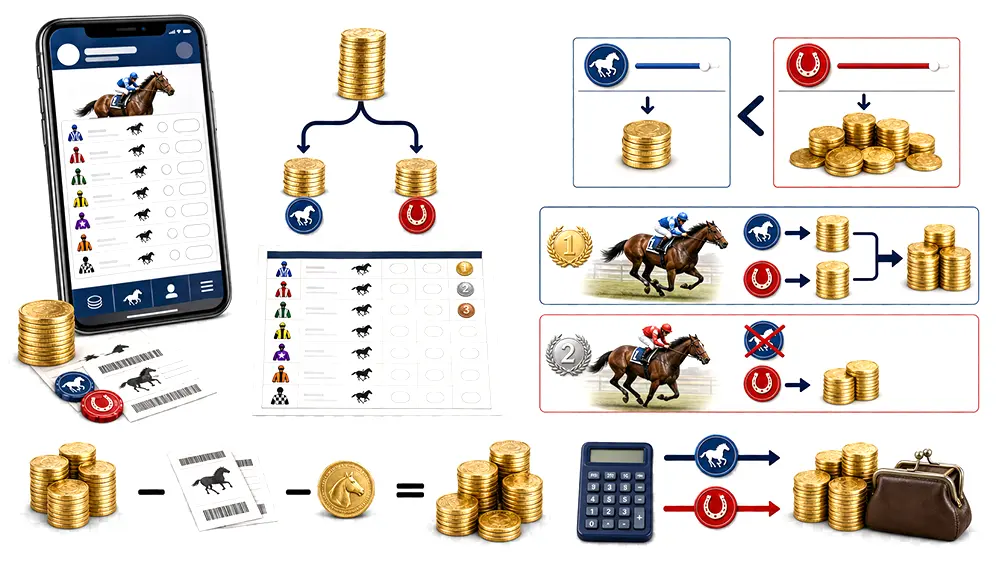
Each way returns start with the unit stake. A £5 each way bet costs £10 because £5 goes on the win part and £5 goes on the place part. Use full odds for the win side, then apply the place fraction to the same price. A 10/1 horse at 1/5 terms gives 2/1 on the place side. Add both returns when the horse wins. Count only the place side when it places without winning. Subtract the full £10 cost for net profit. This payout calculation keeps stake, return, and profit separate.
| Input | Example value | Win part effect | Place part effect | Return effect |
|---|---|---|---|---|
| Unit stake | £5 each way | £5 at full odds | £5 at place odds | £10 total cost |
| Win odds | 10/1 | £55 return if first | Sets place price basis | Higher odds increase both parts |
| Place fraction | 1/5 | No change | 10/1 becomes 2/1 | £15 place return |
| Finishing result | First | Paid | Paid | £70 total return |
| Net profit | £70 minus £10 | Win profit included | Place profit included | £60 net profit |
Inputs you need before calculating returns
Before any calculation, gather the figures shown on the racecard and slip. The selection stake affects cost, while final position decides settlement.
- Total stake: Shows the full amount leaving your balance.
- Unit stake: Splits into equal win and place parts.
- Win odds: Sets the full price for a winning horse.
- Place fraction: Reduces the quoted price for paid positions.
- Paid places: Confirms which finishing spot returns money.
- Final position: Decides whether both parts pay, one part pays, or both lose.
How one fifth place odds work
One fifth terms divide the win price by 5 for the place part. A 10/1 horse becomes 2/1 under standard each way fractions. With a £5 place stake, profit equals £10 and the returned stake adds £5, giving £15 back from that side.
| Win odds | Place fraction | Place odds | £5 place return |
|---|---|---|---|
| 5/1 | 1/5 | 1/1 | £10 |
| 10/1 | 1/5 | 2/1 | £15 |
| 20/1 | 1/5 | 4/1 | £25 |
How one quarter place odds work
One quarter terms pay more than one fifth terms when the win price stays the same. At 10/1, each way place odds become 5/2 rather than 2/1. A £5 place stake returns £17.50, made from £12.50 profit plus the £5 stake.
| Win odds | Fraction | Place odds | £5 return |
|---|---|---|---|
| 10/1 | 1/5 | 2/1 | £15 |
| 10/1 | 1/4 | 5/2 | £17.50 |
| 20/1 | 1/4 | 5/1 | £30 |
Winning horse return example for bettors
A £5 each way bet at 10/1 with one fifth terms costs £10. If the horse wins, both parts pay. The win side returns £55. The place side returns £15. Total return equals £70. After the £10 outlay, net profit is £60 in this payout calculation.
| Bet part | Stake | Odds used | Return | Profit note |
|---|---|---|---|---|
| Win part | £5 | 10/1 | £55 | £50 profit plus stake |
| Place part | £5 | 2/1 | £15 | £10 profit plus stake |
| Total | £10 | Mixed | £70 | Both parts paid |
| Net result | £10 cost | After stake | £60 profit | Return minus total outlay |
Placed horse return example for bettors
Use the same £5 each way bet at 10/1 with one fifth terms. If the horse places but does not win, the win side loses. The place part of each way bet returns £15. Total outlay was £10, so the net result is £5 profit.
| Bet part | Stake | Odds used | Return | Net result |
|---|---|---|---|---|
| Win part | £5 | 10/1 | £0 | £5 lost |
| Place part | £5 | 2/1 | £15 | £10 profit plus stake |
| Total | £10 | Mixed | £15 | Only place paid |
| Net result | £10 cost | After settlement | £15 back | £5 profit |
How each way terms change horse racing payouts
A small terms change can move the payout without changing the horse, odds, or stake. Take £5 each way at 10/1. The bet costs £10. If the horse wins at 1/5 terms, the return is £70. At 1/4 terms, it rises to £72.50. If the horse finishes fourth, 4 places pay, 3 places lose. This is where horse racing payouts often surprise UK bettors.
| Scenario | Stake | Odds | Terms | Payout consequence |
|---|---|---|---|---|
| Winner at 1/5 | £5 each way | 10/1 | 3 places at 1/5 | £70 total return |
| Winner at 1/4 | £5 each way | 10/1 | 3 places at 1/4 | £72.50 total return |
| Second at 1/5 | £5 each way | 10/1 | 3 places at 1/5 | £15 back |
| Fourth paid | £5 each way | 10/1 | 4 places at 1/5 | Place part pays |
| Fourth unpaid | £5 each way | 10/1 | 3 places at 1/5 | No return |
Same odds with different place fractions
The place fraction changes the maths straight away. A £5 place stake on a 10/1 horse pays £15 at 1/5 terms, because the place price becomes 2/1. At 1/4 terms, the price becomes 5/2 and the return rises to £17.50. Better each way place odds add £2.50 here.
Same stake with different paid places
Paid places change the result more sharply than many slips suggest. In a 20-runner handicap, 4 places mean fifth gets nothing. A 5-place offer turns the same finishing position into a return. Extra places horse racing offers still need a price check. A shorter 10/1 with 5 places might be weaker than 12/1 with 4 places.
How short odds reduce place value
Short odds make the place part work hard. A £10 each way bet at 2/1 costs £20. With 1/5 terms, the place price is 2/5. If the horse places but does not win, the return is £14. You still lose £6 overall. Bookmaker margin often cuts this value further.
How long odds increase return potential
Bigger prices give the place part more room. A 20/1 horse at 1/5 terms gives a 4/1 place price, so a £5 place stake returns £25. That looks stronger than a short-price return, but risk rises too. Favourite and outsider odds are not labels. They are prices for different levels of chance.
Horse racing betting systems using each way
Each way ideas belong in horse racing betting systems only when the numbers justify the extra stake. A useful filter starts with field size, odds band, place terms, race type, and price comparison. The method still needs discipline. Track price, implied chance, total outlay, result, and closing odds. A system with no record is opinion with a stake attached.
| Filter | Numerical check | Useful condition | Weak condition | Action |
|---|---|---|---|---|
| Field size | 8 or more runners | 3+ places paid | 4 to 7 runners | Check terms first |
| Odds range | 8/1 to 25/1 | Place return has room | Under 4/1 | Compare win only |
| Race type | 12+ runner handicap | Better place terms likely | Small non-handicap | Read race category |
| Place terms | 1/4 or extra place | Return improves | 1/5 with fewer places | Price the trade-off |
| Market check | 2+ bookmakers | Best price holds | Shorter odds for more places | Calculate return |
| Stake control | 2 equal stakes | Cost fits bankroll | Total stake overlooked | Record full outlay |
How field size shapes your betting strategy
Field size is the first serious filter. Small races offer fewer paid places and often leave little margin for error. Medium fields bring more runners, but terms still need checking. Big handicaps usually give wider prices and more paid positions. Horse racing betting strategies should treat declared runners as a cost signal, not background detail.
| Field size | Typical runners | Place outlook | Pricing issue | Strategy note |
|---|---|---|---|---|
| Small | 2 to 7 | Win only or 2 places | Shorter prices common | Question each way cost |
| Medium | 8 to 15 | Usually 3 places | Terms vary by race | Check fraction |
| Large | 16 or more | 4+ places possible | Odds spread wider | Compare place return |
How odds range filters weak bets
An odds filter removes bets where the place side looks too thin. Short prices often return too little after the full each way cost. Mid-range runners give more balance. Long odds increase payout potential, but the chance drops sharply. A practical horse betting strategy checks margin, price, and terms before stake size.
| Odds band | Place return potential | Win potential | Risk level | Check before betting |
|---|---|---|---|---|
| Under 4/1 | Low | Modest | Lower | Does place return cover cost? |
| 5/1 to 9/1 | Fair | Moderate | Medium | Compare terms |
| 10/1 to 25/1 | Stronger | High | High | Check price drift |
| 33/1 plus | High if placed | Large | Very high | Demand strong terms |
When place betting beats each way
A standalone place bet works better when the win part looks overpriced or irrelevant to your view. The betting exchange place market also gives a separate price for finishing inside the places. That helps when you want no exposure to the win side. Exchange commission reduces final profit, so the net figure matters more than the headline price.
Why large fields suit each way bettors
Large fields attract each way attention because they mix bigger odds, uncertainty, and wider paid-place structures. The Grand National and Cheltenham handicaps show this pattern, especially when firms add places. Cheltenham each way betting still needs price discipline. Extra places mean little when the odds shorten too far.
| Race setting | Runner range | Place terms | Price pattern | Caution |
|---|---|---|---|---|
| Major handicap | 16 to 24 | 4 places standard | Wide odds range | Check late withdrawals |
| Festival handicap | 18 to 28 | 4 to 6 places | Competitive market | Compare several prices |
| Grand National-style race | 30 plus | Extra places common | Many outsiders | Terms differ by firm |
| Small feature race | 5 to 7 | 2 places | Shorter top prices | Each way value often thin |
Rules and promotions that change returns
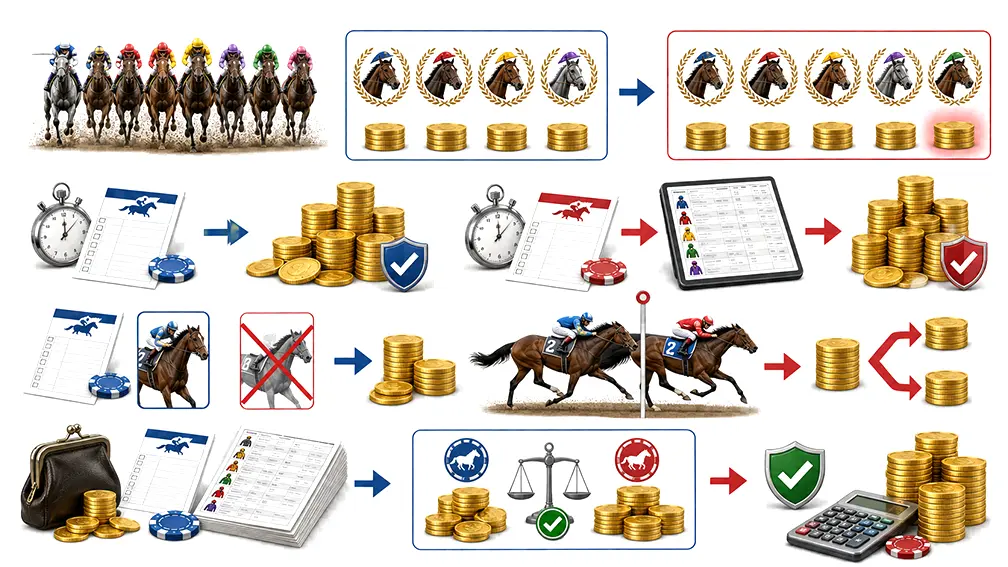
Expected returns often change after a bettor compares prices. Extra places turn a near miss into a payout. A bigger starting price improves some eligible early bets. A non-runner cuts winnings when a Rule 4 deduction applies. Dead heats split the affected part. Starting price also matters because it reflects the final market. Check every offer before staking, not after settlement.
| Rule or offer | Number affected | When it applies | Payout effect | Player check |
|---|---|---|---|---|
| Extra places | 4 places to 5 | Promoted races | One more finish paid | Compare odds |
| Price guarantee | Early price and SP | Eligible racing bets | Bigger price used | Read offer window |
| Rule 4 | Pence per £1 | Horse withdrawn | Winnings reduced | Check deduction shown |
| Non-runner | 1 withdrawn horse | Before race start | Stake returned on withdrawn pick | Review new field |
| Dead heat | 2 or more tied | Tied paid position | Relevant payout split | Check settled return |
| Starting price | Final race price | No fixed price taken | Return follows SP | Know accepted odds |
How extra places affect each way bets
Extra places horse racing offers pay beyond standard terms. A 20-runner handicap might pay 4 places as standard, while a promotion pays 5. That fifth position then earns a place return instead of losing. The offer only helps when the price still stands up. A shorter price with an added place might return less than a bigger price with fewer paid spots.
| Standard places | Extra places | Field size | Qualifying finish added | Value check |
|---|---|---|---|---|
| 3 | 4 | 12 runners | Fourth | Compare fraction |
| 4 | 5 | 20 runners | Fifth | Check price cut |
| 5 | 6 | 24 runners | Sixth | Review total return |
How best odds guaranteed can help
Best odds guaranteed links an early price to the starting price. If you take 6/1 and the SP is 8/1, eligible bets settle at 8/1 under that offer. If SP is shorter, the accepted early price stays. Terms decide which races, times, bet types, and accounts qualify, so read the slip label before relying on the bigger price.
| Early price | SP | Settled odds | £10 win return | Effect |
|---|---|---|---|---|
| 6/1 | 8/1 | 8/1 | £90 | Return rises by £20 |
| 6/1 | 5/1 | 6/1 | £70 | Early price protected |
| 10/1 | 10/1 | 10/1 | £110 | No change |
How Rule 4 deductions affect returns
A withdrawal shortens the remaining field. Bookmakers then reduce winnings because the chance on every remaining horse has improved. The non runner deduction depends on the withdrawn runner’s price. A short favourite creates a bigger cut than an outsider. This affects each way returns too, because both win and place winnings face the relevant adjustment.
| Withdrawn horse price band | Deduction level | £100 winnings impact | Reason | Player note |
|---|---|---|---|---|
| 1/9 or shorter | 90p in £1 | £90 deducted | Market leader removed | Major return cut |
| 2/5 to 1/3 | 40p in £1 | £40 deducted | Strong chance removed | Check revised payout |
| 4/1 to 11/2 | 15p in £1 | £15 deducted | Mid-price horse removed | Deduction still matters |
| Over 14/1 | 0p in £1 | £0 deducted | Outsider removed | Place terms still matter |
How dead heat rules split payouts
Dead heat rules apply when 2 or more horses share a paid position. The tied part is divided by the number of horses involved, then settled at the relevant odds. If 2 runners tie for the final place, half the place stake is treated as winning and half as losing, depending on the bookmaker method.
| Tied runners | Stake affected | Place odds | Adjusted return | Payout effect |
|---|---|---|---|---|
| 2 | £10 place stake | 2/1 | £15 | Half stake wins |
| 3 | £10 place stake | 2/1 | £10 | One third stake wins |
| 2 | £5 place stake | 4/1 | £12.50 | Reduced tied return |
Common each way betting mistakes to avoid
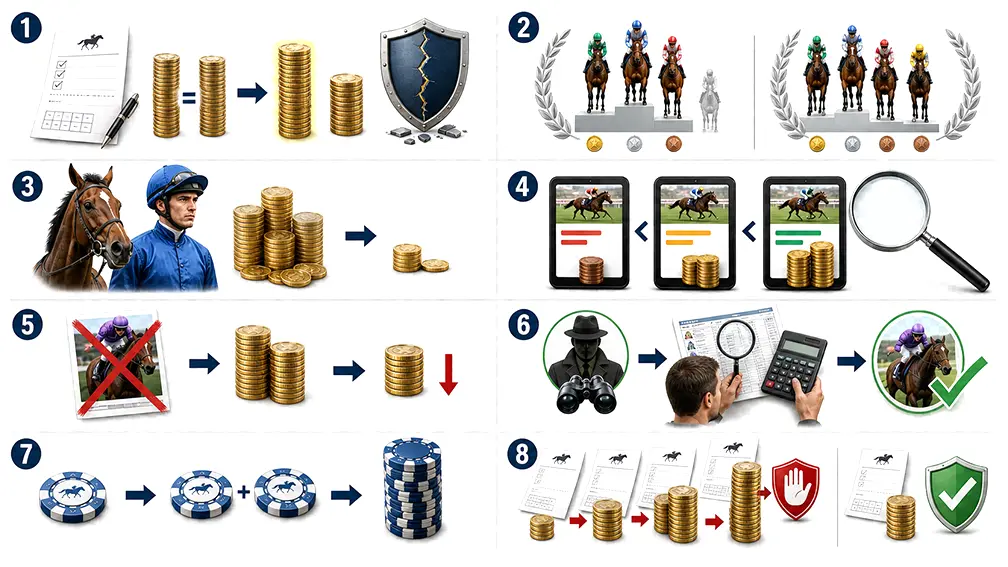
Each way betting fails fast when the slip looks safer than the maths. The main risk is paying twice for weak cover. Treat the bet as 2 priced opinions, not a refund plan. Keep stake size controlled, compare the market, and stop when the total cost no longer fits your budget.
- Calling it insurance: The place part costs extra. Fix it by checking whether the return covers the full stake.
- Ignoring terms: Three places and 4 places create different outcomes. Fix it by reading paid positions before staking.
- Backing short prices: A 2/1 place return at 1/5 terms is small. Fix it by comparing win only.
- Missing price comparison: Bookmaker margin varies. Fix it by checking several firms before confirming.
- Forgetting withdrawals: Non-runners change fields. Fix it by reviewing deductions and revised terms.
- Following tips blindly: Betting tips horse content means little without price. Fix it by checking value first.
- Confusing unit stake: £5 each way costs £10. Fix it by reading the total stake.
- Chasing losses: Bigger each way stakes add risk. Fix it with deposit limits and a firm stop point.
Each way betting FAQ for UK bettors
What is an each-way bet?
It is 2 bets on one horse. One part needs the horse to win. The other needs a paid place. A £5 each way stake costs £10.
What does 1/4 or 1/5 mean?
These fractions set the place odds. A 10/1 runner pays 5/2 at 1/4 terms, or 2/1 at 1/5 terms.
How many places count?
The race terms decide this. Small fields might pay 2 places. Larger handicaps often pay 3 or 4. Promotions sometimes add more.
What happens if my horse is a non-runner?
Your stake normally returns on that selection. Other runners in the race might face a deduction from winnings.
What if the number of runners changes?
Runner changes can alter place terms. An 8-runner race dropping to 7 runners might reduce the paid positions.
What does an each way bet cover?
It covers a win and a qualifying place. It does not cover every good run, and it does not protect your full stake automatically.
Where is the best place to make each way bets?
A stronger slip usually has fair odds, clear terms, fair place fractions, and useful extra places without a heavy price cut.
What is the difference between bookmaker odds and exchange odds?
Bookmaker prices come from the firm. A betting exchange matches customers, often with commission on winnings.
What are the most common reasons bets are settled differently than expected?
Non-runners, Rule 4, dead heats, changed place terms, SP settlement, and unticked each way boxes cause most payout surprises.

James Whitmore is Editor-in-chief at BookiesReviews.co.uk, where he leads bookmaker reviews, betting guides and UK sports betting coverage. James is a football, horse racing and boxing fan, a Burnley supporter, and follows the NFL through the Green Bay Packers.His industry experience includes roles with Betfair, Paddy Power and Oddschecker, giving him practical knowledge of bookmakers, odds comparison and player-focused betting content.